



D J
shared a thread session in group #Sleep
I need to start paying attention to my RHR (Resting Heart Rate)
"nothing predicted my sleep quality better than my RHR right before bed. If it was around 45 bpm, I was guaranteed a perfect night's sleep. 50 bpm would reduce sleep quality by ~20% and 55+ bpm ~35%. 60 bpm and torture awaited."
#Sleep

@dvdaines
https://x.com/dvdaines/status/1883549619822658030
I thought @bryan_johnson's idea of building your life around asleep was ridiculous, but after trying it for a week, I'm sold.
→ Brain works better
→ Feel awesome all the time
→ Get more done in less time (Parkinson's Law)
Caveat: I do not have children.

@bryan_johnson
https://x.com/bryan_johnson/status/1883702802071077289
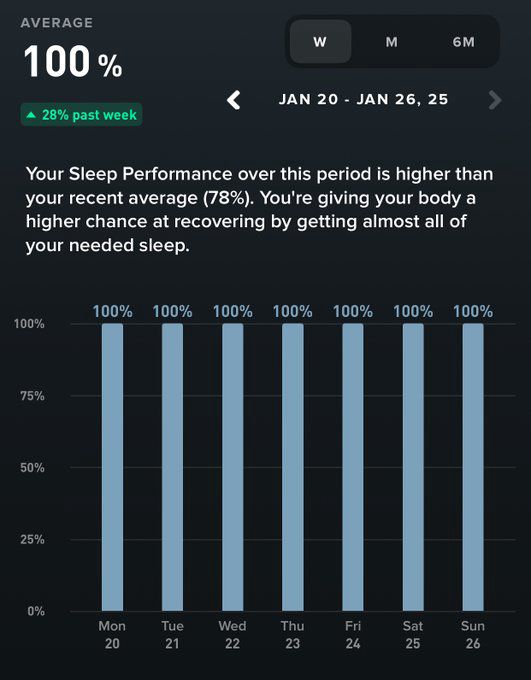
I completed eight consecutive months of 100% sleep using @WHOOP. Not knowing what you have in place now, I'll share the things that I think had the greatest effect:
1. Resting heart rate - nothing predicted my sleep quality better than my RHR right before bed. If it was around 45 bpm, I was guaranteed a perfect night's sleep. 50 bpm would reduce sleep quality by ~20% and 55+ bpm ~35%. 60 bpm and torture awaited.
2. All habits and systems then became about lowering RHR. My final meal of the day had the greatest effect. I started with two hours before bed and worked my way back to ~9 hours now. What you eat and total calories also has a large effect. Some foods such as breads and pasta's elevate RHR. Through trial and error, I learned what foods increased and decreased RHR. If you want to try and replicate what I've learned, you can try my dd food guide.
3. Other things that lower RHR include light: a) using red and amber lights an hour or two before bed and eliminating blues b) calming music.
4. I found that my nightly wind down routine was also a power law. Transitioning from a sympathetic nervous system state (fight or flight) to parasympathetic (calm). What worked for me is having an internal dialogue, listening to Ambitious Bryan's new ideas, Anxious Bryan's worries, and Dad Bryan's thoughts on the kids. Basically acknowledging their needs and thoughts and writing them down. This technique substantially reduced rumination loops which wreck sleep. Successfully doing this will drop RHR nearly as much as having good food hygiene (eating time and food type).
5. I avoid stimulants past noon knowing that caffeine has on average a 6 hour half life. I previously stopped caffeine entirely as it created mood swings but recently reintroduced it via matcha as it creates a pleasant mental state without the swings and doesn't negatively effect my sleep.
6. One of the highest performing daily habits is reading a book for 20 minutes right before I go to sleep. It has to be a book that I hold in my hand and I have to be 100% concentrated on it. No screens.
7. Consistency of bedtime and routines - when I was did the eight months of perfect sleep, my routine was within +/- 1 min precise and my body responded with surprisingly strong performance. Consistency is underrated for the power it offers.
8. My room is blacked out and I have an @eightsleep bed.
Daily I would target:
+ asleep within 2-3 minutes
+ 2 hours of Deep
+ 2 hours of REM
+ up for less than 30 min.
I tried various supplements but none really made a huge difference. Well executed habits seem to outperform. I do take 300 mcg of melatonin each night but otherwise don't take anything for sleep.