shared a media post in group #Sleep
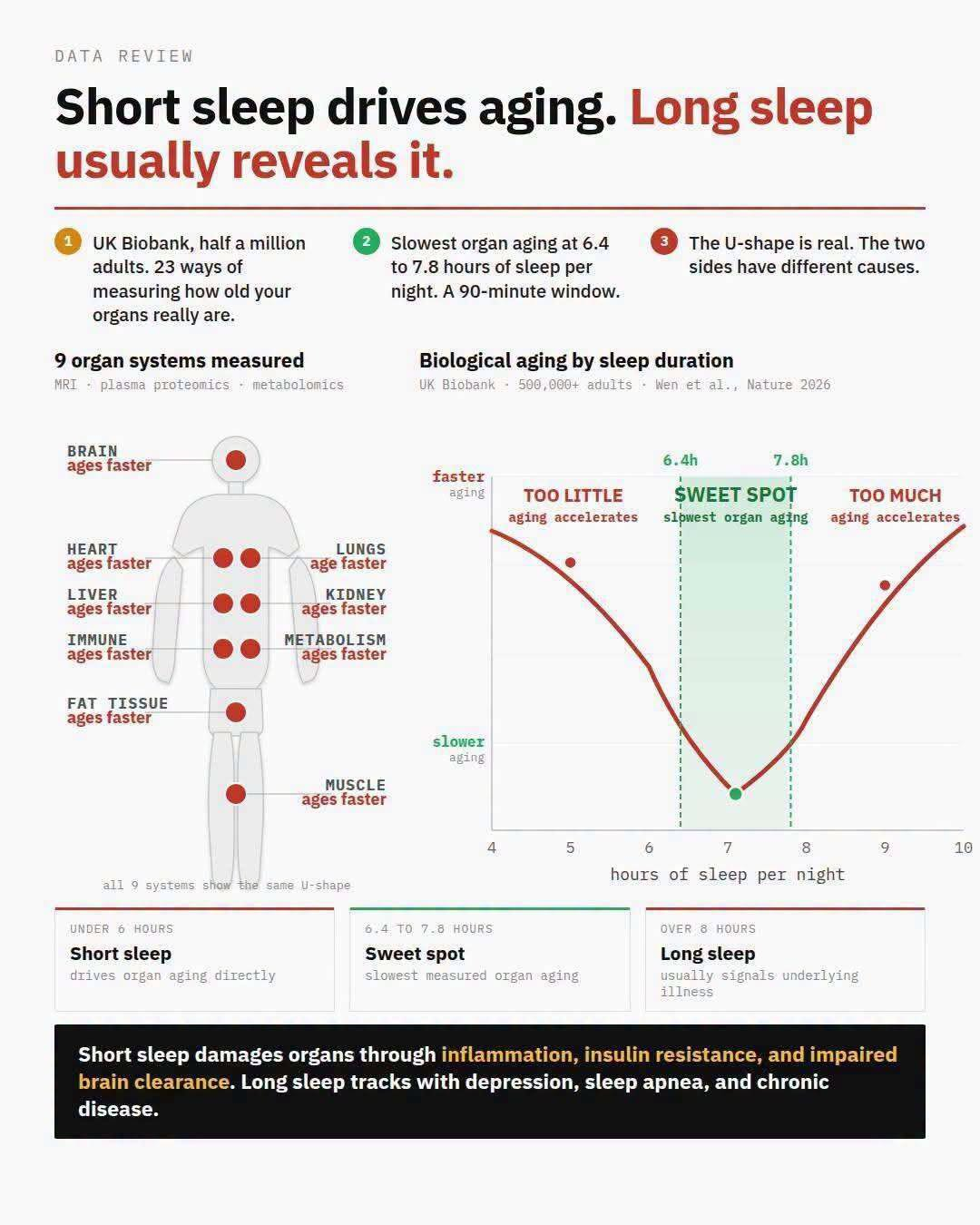
Most people think of #Sleep as a simple more-is-better habit, but a large Nature study suggests the story is different on each side of the clock. Sleeping too little appears to speed up aging, while regularly sleeping a lot is more often a sign that something is already wearing the body down.
The paper, led by Junhao Wen's lab at Columbia, compared sleep habits with signs of biological aging across 9 organ systems in about half a million UK Biobank adults aged 37 to 84. The team used 23 different aging clocks built from MRI scans, blood proteins and metabolites. The pattern was U-shaped. Organs looked youngest in people who slept between about 6 and a half and just under 8 hours a night, and outside that window, in either direction, organs looked older than a person's actual age would predict. #Data is beautiful
The two sides of that curve are not the same biology. On the short side, the evidence that poor sleep causes harm is strong. Sleeping under 6 hours raises inflammation throughout the body, makes it harder to handle sugar the next morning, weakens a type of immune cell that fights infections and early cancer, and is linked to poorer overnight clearing of waste from the brain. Genetic analyses, including the ones in this paper, support short sleep directly speeding up aging.
#Leverage Your Biology
On the long side, the picture flips. Regularly sleeping more than 8 or 9 hours is a well-known marker of illness rather than something harmful in itself. It tends to travel with depression, undiagnosed sleep apnea, an underactive thyroid, chronic inflammation and diseases of the brain and nerves. The authors could not rule out that the illness comes first, and decades of earlier sleep research suggest that for most long sleepers, the extra sleep is the body trying to make up for a problem that is already there.
That difference matters because the advice for the two groups points in opposite directions. If you sleep under 6 hours, the best-supported changes are giving yourself more time in bed, keeping a steady bedtime and wake time, getting morning light, stopping caffeine after lunch and finishing alcohol at least three hours before bed. Small trials that added roughly 45 to 90 minutes of sleep a night have shown improvements in blood sugar and heart health markers.
If you regularly sleep 9 or more hours and still wake up tired, it is worth finding out what your body is recovering from. A doctor can check for sleep apnea with a home sleep study, run blood tests for thyroid function, iron stores, inflammation, vitamin D and vitamin B12, screen for depression and anxiety, and review medicines that can increase the need for sleep, such as some antihistamines, nerve pain drugs, certain antidepressants and beta blockers.
Some people genuinely need 9 to 10 hours, including athletes in heavy training, teenagers, people getting over an infection and women early in pregnancy, and this curve does not apply to them in the same way. The study looked at the usual sleep habits of adults aged 37 to 84, not at short periods of recovery.
Taken together, there is a window in the middle where the body looks youngest on every clock the researchers built, and both sides of that window go with faster organ aging. Short sleep seems to cause the damage, while long sleep usually signals that damage is already underway.
References
Wen et al., Nature, 2026
Cappuccio et al., Sleep, 2010
Irwin, Nature Reviews Immunology, 2019
Spiegel et al., The Lancet, 1999
Tasali et al., JAMA Internal Medicine, 2022
Besedovsky et al., Physiological Reviews, 2019